
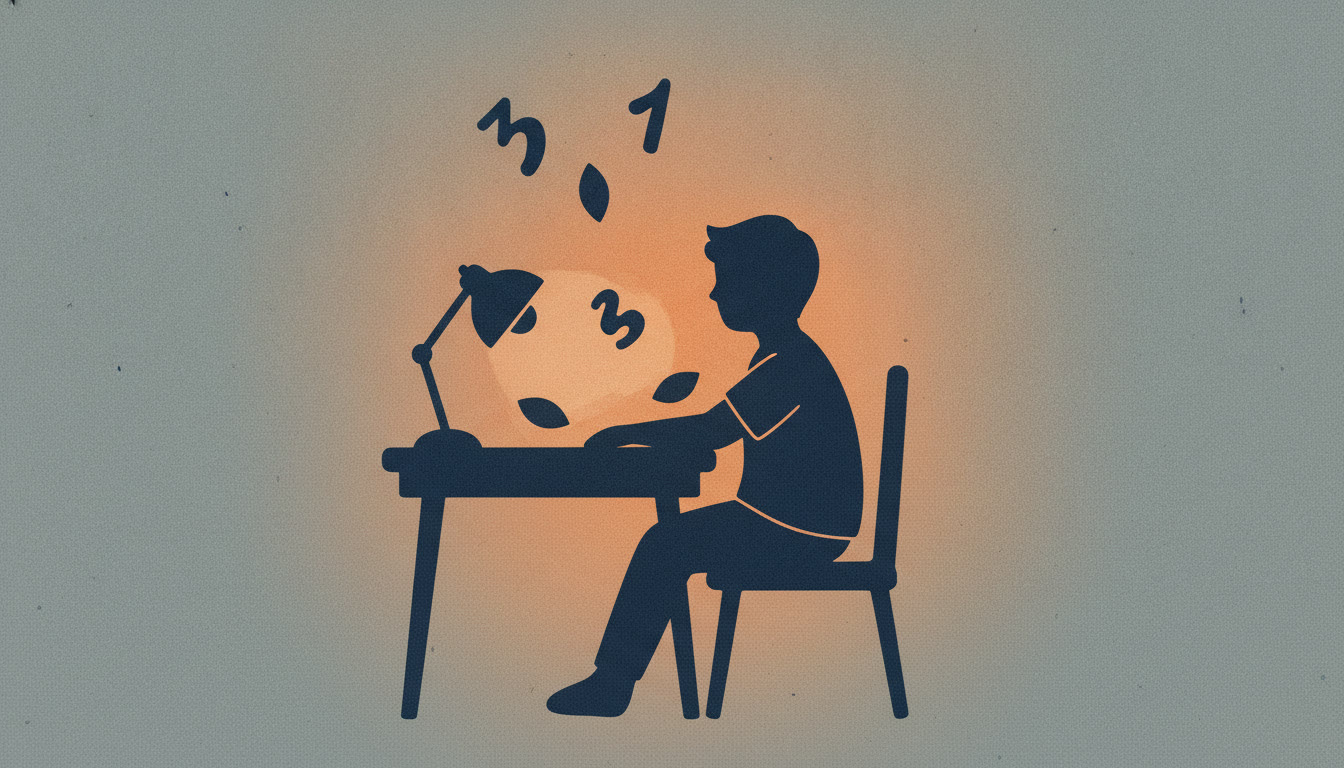
It usually arrives at the end of a hard evening at the homework table. The page is thin from erasing, the eyes stay down, the voice drops: “I’m bad at math.” Four small words, and the air in the room changes. Because you can hear it too: this is not a comment about a school subject. Your child is about to reach a verdict about themselves.
The sentence deserves to be taken seriously, just not on its own terms. A child who says “I’m bad at math” is not sharing an assessment. They are summarizing accumulated exhaustion, repeated embarrassment, and an anxiety that has grown too heavy to carry alone. Left unanswered, the sentence doesn’t fade. It grows up with its owner. Adult dyscalculia forums are full of its thirty-year-old versions, people still writing “I feel so stupid” from in front of a checkout or across a dinner table. That is exactly why the answer you give at the kitchen table tonight matters.
The sentence is a conclusion, not an observation
First, the ground truth. If your child has dyscalculia, or you suspect it, there is a real neurological difference here. Number sense, comparing quantities, holding the steps of a calculation in mind: these genuinely work differently in your child’s brain. It is not laziness, not carelessness, and not intelligence. So when your child says “this is hard for me,” they are right. The struggle is not imagined.
But “I struggle with this” and “I’m bad at this” are not the same sentence. The first describes an experience. The second builds an identity. And what builds that second sentence is usually not the dyscalculia itself but the anxiety layered on top of it. Seeing that difference changes everything, because you cannot remove dyscalculia, but you genuinely can deflate the anxiety layer. That is the part of your child’s relationship with math where you have the most say.
How anxiety steals math
Math anxiety is not a soft concept; the mechanics are well understood. Anxiety occupies working memory, and working memory is precisely where math happens: carrying the one, tracking the steps, connecting the start of a problem to its end. An anxious mind has rented part of that space out to “what if I can’t do this.” There is simply less room left for the math.
The result is a cruel loop. An anxious child genuinely performs worse; that bad moment looks like “evidence”; the evidence feeds the anxiety; the bigger anxiety sabotages the next attempt. Before long the child fails tests on material they actually know. The problem they solved calmly at home on Tuesday, they stare at frozen at the whiteboard on Thursday. Adults often read this inconsistency as “not trying.” What you are actually seeing is the space anxiety has stolen from working memory.
The loop also keeps crooked books. An anxious child does not weigh successes and failures on the same scale. The right answers were “luck” or “an easy question.” The wrong ones are “that’s just who I am.” Adults with dyscalculia describe this accounting in exactly those words: credit goes outward, blame goes inward. Until the books are corrected, no amount of progress moves the balance out of the red, because the system is rigged. It is the sibling of what we wrote about a child’s negative inner voice, the same machinery, running on numbers.
What to say in the moment
When “I’m bad at math” lands, most of us reach for the same reflex: “Don’t say that! You’re so smart.” Well meant, and doubly wrong. First, it bans the feeling your child just trusted you with; the lesson learned is “I shouldn’t say this again,” not “I don’t need to feel this.” Second, your child doesn’t believe you. The eraser-worn page in front of them is more convincing than your sentence.
A better sequence:
- Hear it first, correct it later. “It really felt that way tonight, didn’t it? That was a rough page.” A feeling that gets acknowledged shrinks. A feeling that gets banned goes underground and grows.
- Move the sentence from identity to event. Trade “I’m bad at math” for “this problem got stuck.” “You’re not bad at math. This problem doesn’t open with the way it was explained to you, so we’ll try another way.” The difference is not politeness, it is architecture: one lays a brick into identity, the other leaves an event an event.
- Name the difficulty without drawing a ceiling. If your child has dyscalculia, hiding it does not work; children name unnamed struggles themselves, and the word they usually pick is “stupid.” “Your brain processes numbers differently, so some things take more work” is honest and has no ceiling in it. “You’ll never be a math person” is not honesty, it is a forecast nobody ordered.
- Tell your own math story carefully. “Oh honey, I was always terrible at math too, it runs in the family” feels like solidarity but works like a verdict. That is not an inheritance to hand down. “I struggled too. I wish someone had told me to slow down” builds the same closeness without closing the door.
Confidence is rebuilt with evidence, not pep talks
The way to fix anxiety’s crooked books is to hand your child small pieces of evidence they cannot argue with. And the best venue for that is daily life, not the homework table, because right now the homework table feels like a courtroom, and nobody relaxes in a courtroom.
- Let math live where there are no grades. Measuring a recipe, keeping a small budget at the store, working out “how many minutes until we’re there” in the car. None of these are tests, and all of them are math. If a child only ever meets math where the red pen lives, being afraid of it is a reasonable response.
- Clocks and money are the two best arenas. Both are concrete, both are obviously useful, and both are exactly where children with dyscalculia struggle and feel ashamed most often. That is why our free Clock & Money tool starts there: no pressure, no timer, five-minute practice at home. For numbers that stay stubbornly abstract, the Number Line does the same job, turning a number from something held in memory into something you can look at.
- Set winnable tasks. Confidence comes from the child forming the sentence “I couldn’t do this yesterday, and I can today” on their own. Make the task so small that success is nearly guaranteed, then let it grow one notch at a time. That is what a ladder is, and nobody criticizes a ladder for having a low first rung.
- Make progress visible. Progress with dyscalculia is slow and quiet. If nobody makes it visible, the child never sees it; they only see what they still can’t do. Keep a small record so you can say “in September you were here, and look what you’re doing now.” For the wider picture of home support, our dyscalculia at home guide is the companion piece.
What not to do: four reflexes that feed the loop
- No timers, no races. “Quick, what’s seven times eight” is not a game for a child with dyscalculia, it is a panic drill. Speed pressure is anxiety’s fastest route into working memory. It is one of the first things resources like Understood tell parents: skill is built by calm repetition, not by the clock.
- Don’t say “this is easy.” It is said to help, and it does the opposite. If the question is easy and the child still can’t do it, there is only one conclusion left for them to draw. “This one is genuinely tricky” is usually more accurate, and it makes the struggle legitimate.
- Don’t teach mid-panic. Nothing explained through tears gets learned; an anxious brain is not in learning mode. Closing the notebook is not surrender. “We’ll crack this tomorrow with a fresh head” is both a sound learning decision and a message that your child’s feelings outrank the worksheet.
- No comparisons, not with siblings, classmates, or yourself. However “your sister at your age…” was supposed to end, all your child hears is their place in a ranking. The only fair comparison for a child with dyscalculia is who they were yesterday.
The day you hear the sentence
The day “I’m bad at math” first arrives, there is only one thing to do: take it seriously and translate it correctly. Your child is showing you their anxiety, not their ability. The dyscalculia is real, the struggle is real, but “I’m bad” is not a diagnosis. It is the accumulated sound of hard moments nobody met. Hear it without banning it, move it from identity to event, and walk math out of the courtroom and into the kitchen, the store, the clock on the wall. The sentence slowly goes out of date.
Your child does not have to fall in love with math. Learning to live without fearing it is enough, and it is entirely within reach. Start small today: measure a recipe tonight, play a five-minute clock game this weekend. For everything else, the Kindlexy tools are always here.